
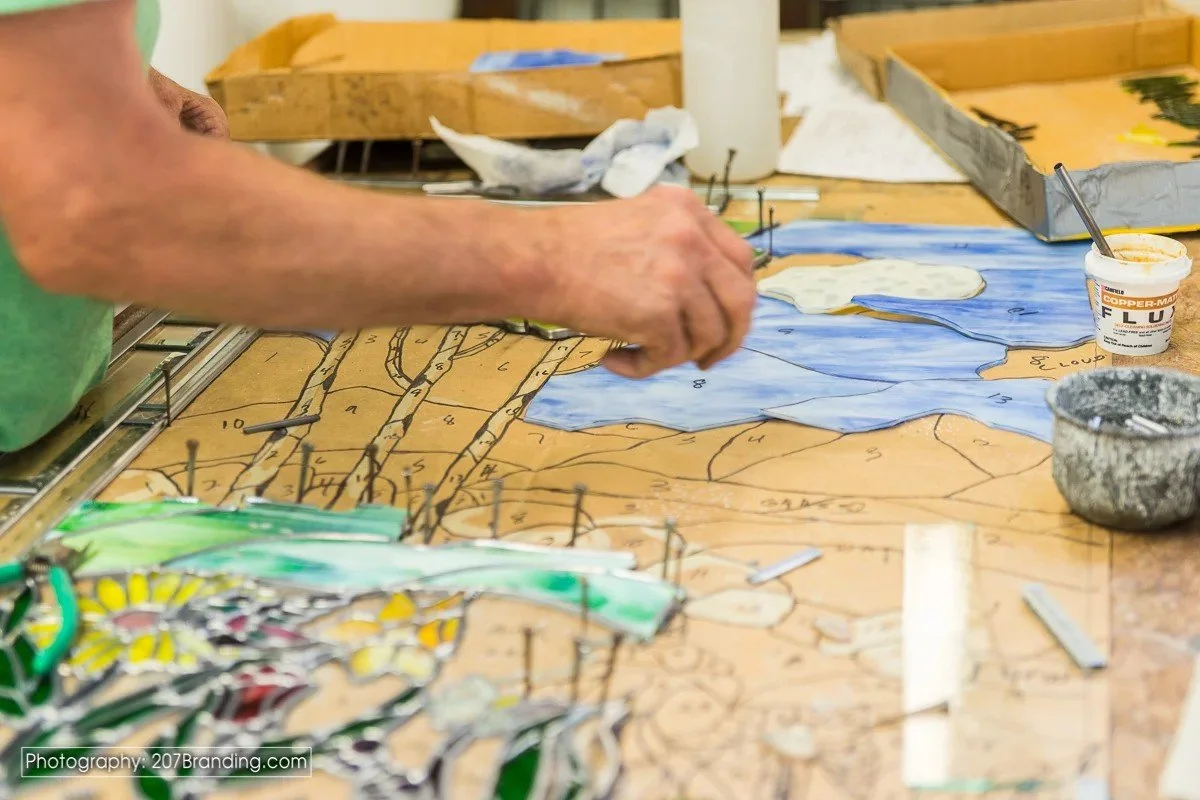
Copper Foil vs. Leaded Stained Glass: Why I Combine Both
/Quick answer: The difference in copper foil vs leaded stained glass is how the pieces are joined: copper foil wraps each piece in thin copper and solders every seam for fine detail, while leaded glass sets pieces in H-shaped lead came for strength and clean lines. I'm Steve Downing, and at The Glass Master in Thornton, CO, I combine both methods so a window can look almost painted and still be built to last. I work with homeowners across the Denver metro; call me at (303) 457-1886.
Two Stained Glass Techniques, One Goal
Every stained glass piece faces the same challenge: dozens or hundreds of separate pieces need to become one strong panel. People ask me about the two main stained glass techniques all the time, so here's how I'd explain it at my workbench.
How Leaded Stained Glass Works
Each piece is cut to the pattern and slipped into lead came, a soft metal channel shaped like an "H." The joints are soldered, and cement is worked under the lead to seal and stiffen the panel.
Lead is great for strength in larger windows and doors, bold lines that read from across a room, and classic looks like clear beveled and diamond patterns. Its limit is width: very small pieces and tight curves are hard to do in lead alone.
How Copper Foil Stained Glass Works
Each piece is edged with thin adhesive copper foil, fitted together on the pattern, and soldered along every seam, front and back. It's the approach associated with Tiffany's lamps and windows.
Copper foil stained glass excels at small pieces, tight curves and painterly shading. On its own, though, a large foil panel doesn't have the built-in structure of lead.
Copper Foil vs. Leaded Stained Glass at a Glance
- Detail: foil wins for small pieces; lead is better for bold, simple lines.
- Strength: lead gives large panels more structure.
- Look: lead lines are wider and graphic; foil seams are thinner and blend in.
- Best uses: lead for doors, large windows and geometrics; foil for florals and detailed accents.
Why I Combine Both
When I first saw original Tiffany windows in Washington, D.C., I was struck by how they looked painted. I've chased that effect since I founded The Glass Master in 1989. But I build for real homes, with doors that open and close all day and Colorado weather outside.
So in the same window, I use copper foil where I want fine detail, like the petals in a floral transom, and lead where the piece needs strength. That combination is my signature.
You don't need to know any of this to work with me. When we design your piece together, I'll suggest the right mix for the opening and the detail you want.
Frequently Asked Questions
Is copper foil or leaded glass stronger?
Leaded glass generally gives large panels more structure, which is why I pair copper foil detail with leaded construction in bigger pieces.
Which method is better for a front door?
Door glass handles daily use, so leaded construction plays a big role. Detailed accents can still use copper foil.
Do you repair both kinds of stained glass?
Yes. I work in both methods every day, so I'm comfortable evaluating pieces built either way.
Let's Talk About Your Piece
About The Glass Master: The Glass Master is a custom stained glass studio owned by Steve Downing in Thornton, Colorado, serving Denver and the north metro, including Westminster, Northglenn, Broomfield, Arvada and Brighton. Phone: (303) 457-1886.
If you're curious how the two could come together in your home, call me at (303) 457-1886, 7am to 5pm daily, or send a message. Read more about me or browse the stained glass gallery.


